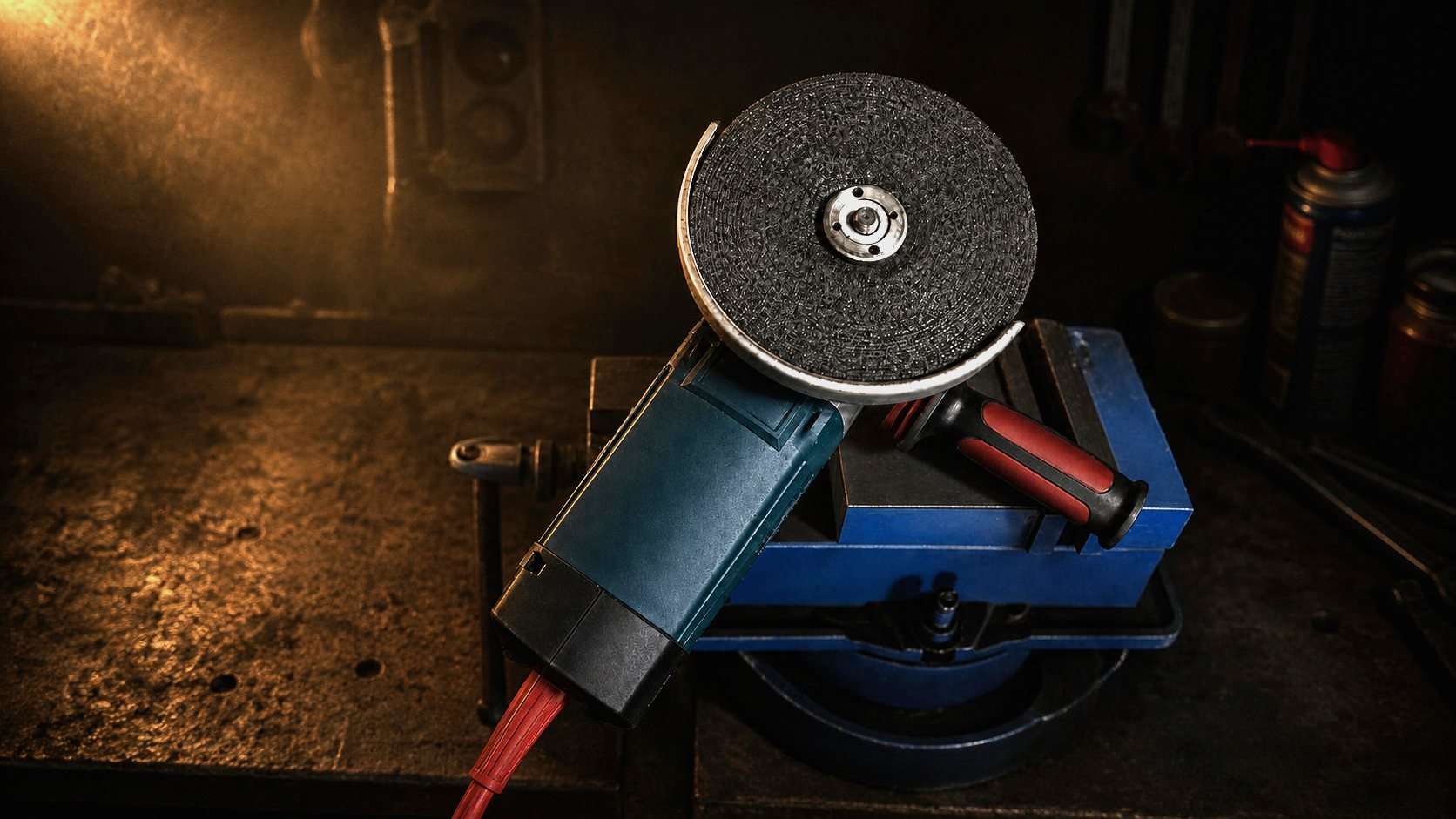
The angle grinder is one of the most versatile and efficient power tools for cutting metal. However, without the right angle grinder discs and proper usage, it will be difficult to achieve good performance or effectively meet your needs. Here is my guide to cutting metal with an angle grinder.
When to Use an Angle Grinder for Cutting Metal ?
The primary feature of an angle grinder is its flexibility, making it easy to carry and move around. This allows for flexible cutting locations, making it suitable for on-site construction, work at heights, and operations in confined spaces. Additionally, it requires short setup time and offers high work efficiency.
Angle grinders are suitable for the following scenarios:
- Cutting extremely hard metals that ordinary hand saws cannot cut or can cut only with very low efficiency.
- Cutting small amounts of steel, bolts, or pipes during on-site installation or maintenance.
- Localized cutting in steel structure, building, and ship repair work.
- Large workpieces that are difficult to transport to a bench-top cutting machine.
- Metal parts that need to be cut first and then finished with other processes.
How to Choose the Right Cutting Disc?
For many buyers, the search starts with a practical question: which angle grinder cutting disc for metal matches the workpiece and tool? It’s important to choose angle grinder attachments.
What is the Best Cutting Disc for Metal?
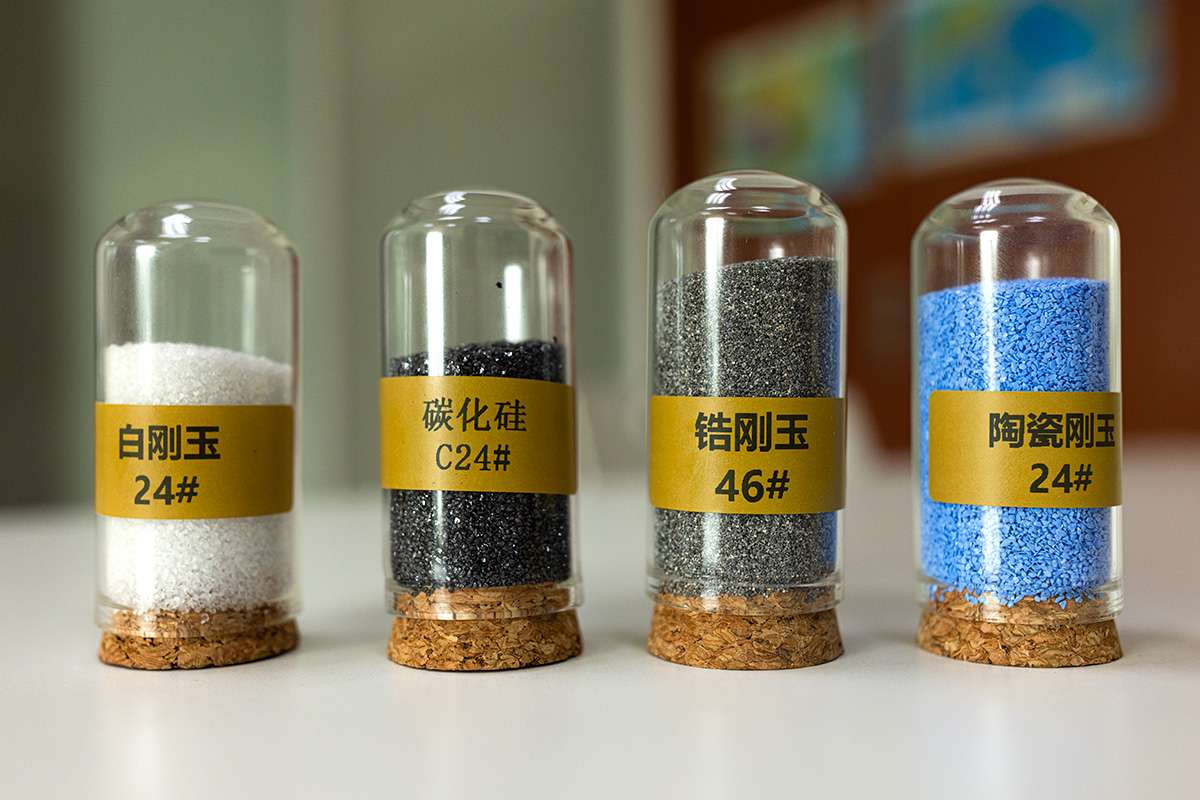
First, you are supposed to identify the material of the workpiece, then check the label on the cutting disc. You cannot indiscriminately use the same type of cutting disc for different materials.
For instance, past experience shows that a disc designed for ordinary steel can become clogged with aluminum chips when cutting aluminum. Instead, you should use an aluminum cutting disc, which contains aluminum oxide and silicon carbide abrasives.
Optimal performance is achieved only when the cutting disc for angle grinders is matched to the workpiece material.
The following is a detailed selection reference table.
| Workpiece material | Abrasive grain | Bond & reinforcement | Product |
| Carbon-steel bolt, rebar or angle bar | Aluminum oxide | Reinforced resin bond | Steel Cutting Discs |
| Stainless-steel pipe or sheet | White fused alumina with zirconia coating | Low-contamination resin bond with fiberglass mesh | Metal & Stainless Cutting Discs |
| Aluminum profile or thin sheet | Non-ferrous-rated abrasive | Resin bond with anti-loading formulation | Aluminium Cutting Discs |
Choose by Shape
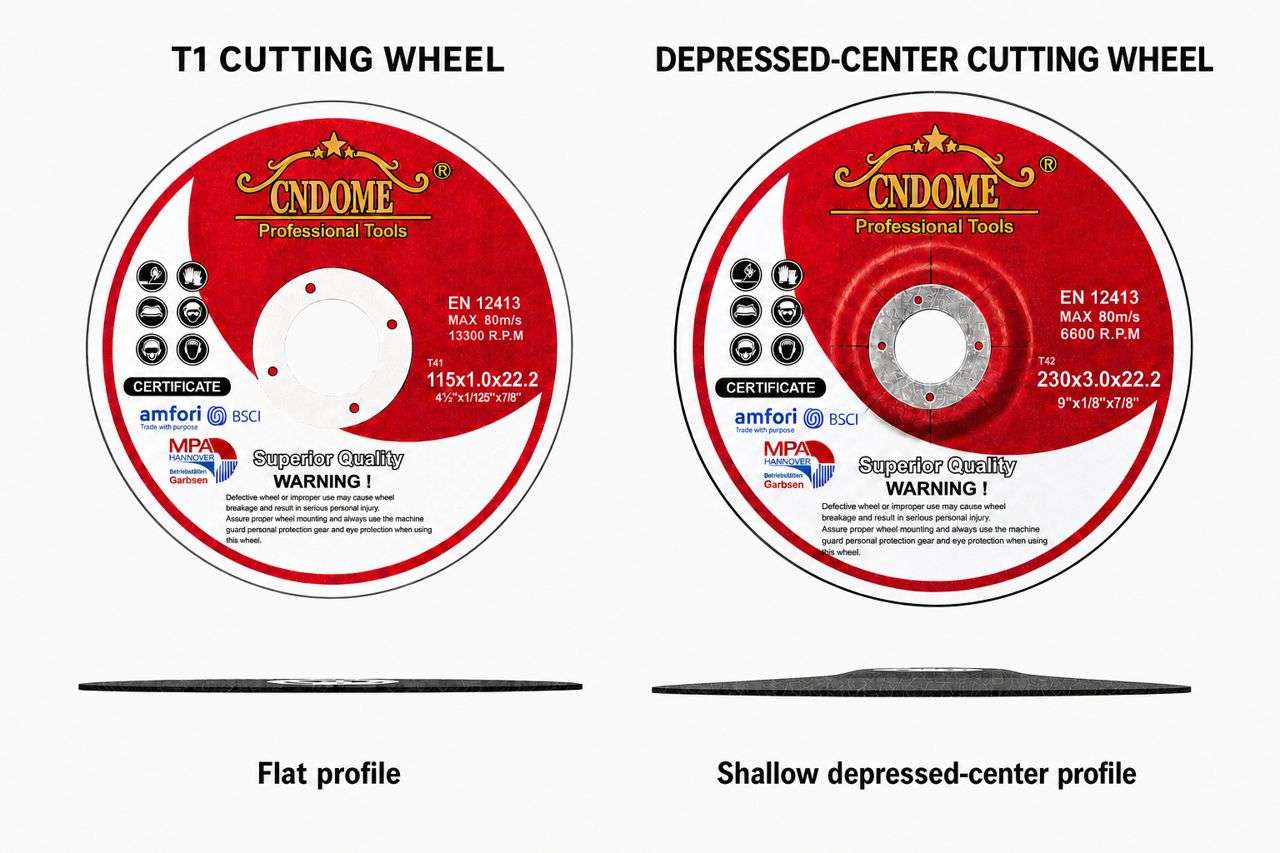
Type 1 Cutting Discs
- Advantages
Due to the fact that the disc is entirely flat, the angle grinder’s clamping nut and any parts that stick out do not affect cutting. So that, you can make full use of the disc radius and enable deeper cuts. Moreover, it has a simple design and the cutting gap is typically narrow.
- Limitations
When cutting thicker profiles, you can not force the tool into the progressively narrowing cutting gap. Otherwise, the disc is likely to get caught. It is also unsuitable for performing edge-to-edge or flush cutting.
Type 27 Cutting Discs
- Advantages
The T27 Depressed Center Cutting Wheel gives very good flush cutting abilities. You can remove any projections right against the surface of the substrate without any problems caused by nuts.Their thickness typically ranges from 1.2 mm to 3.2 mm, which balances the efficiency of rapid cutting with higher structural stability.
- Limitations
There is a bend and indentation in the center of the wheel, causing uneven stress distribution, which makes it easy to shift during vertical cutting. What’s more, it has a limited cutting depth.
Type 1 Cutting Disc VS. Type 27 Cutting Disc
| Comparison Point | Type 1 Disc | Type 27 Disc |
| Structure | Completely flat disc | Depressed center design |
| Kerf | Usually has a narrower kerf | Usually wider and thicker |
| Cutting Depth | Allows better use of the disc radius for deeper cuts | Limited by the depressed center and flange area |
| Flush Cutting Ability | Poor, not ideal for edge-to-edge or flush cutting | Strong, suitable for cutting close to the surface |
| Cutting Straightness | Better for straight and stable cutting | More likely to shift during vertical cutting |
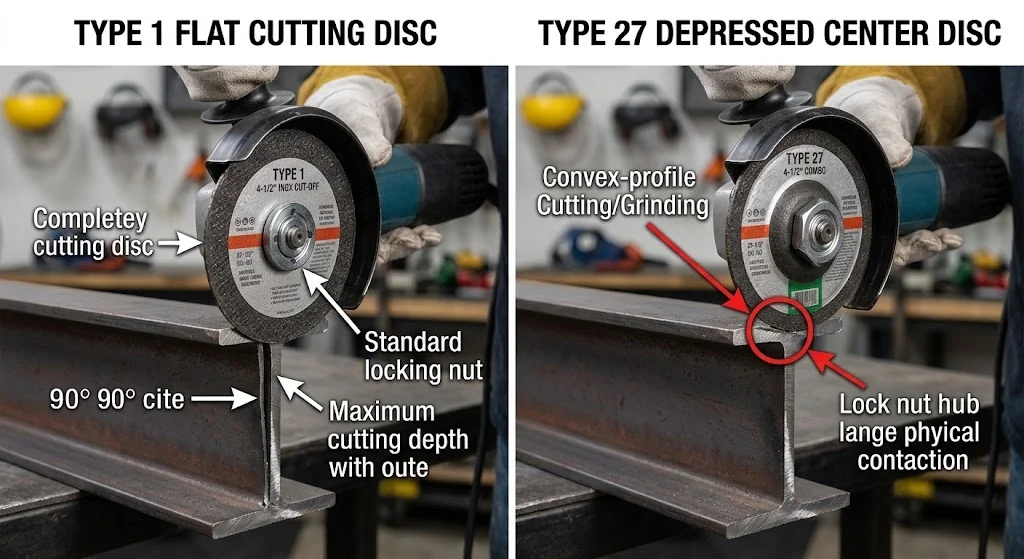
For example, if you require cutting thick steel with an angle grinder , you can opt for a T1 cutting wheel to match the cut off wheel grinder, making fuller use of the disc radius. However, the cutting depth of T27 wheels is limited by the depressed center and the flange.
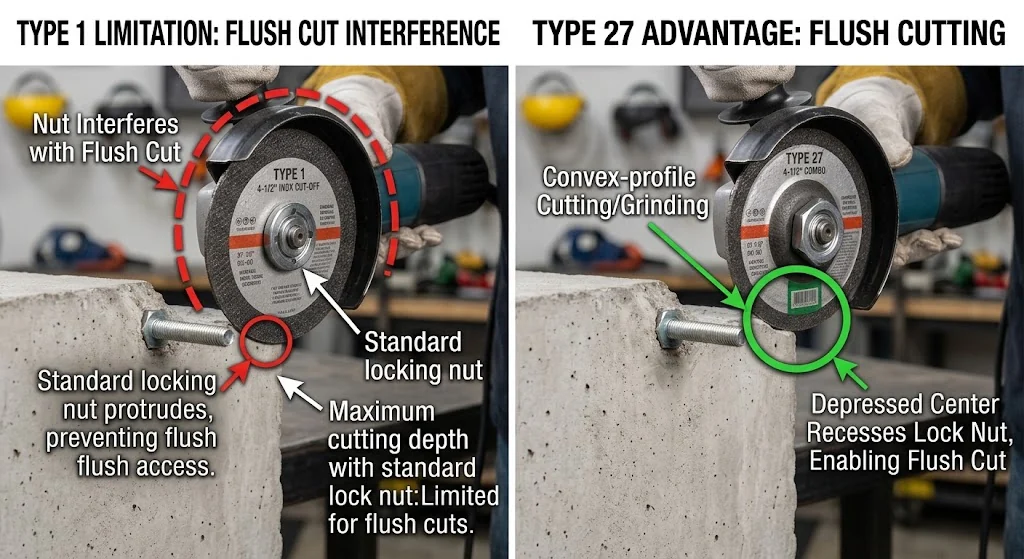
If you need to cut workpieces with protrusions, such as nuts, you can choose a T27 cutting wheel instead of a T1 wheel.
Choose by Disc Thickness
Thinner discs produce narrower kerfs and cut faster, but are more influenced by bending and lateral forces. Thicker discs offer greater rigidity, but result in wider kerfs. They may cause higher material loss and generate more heat.
The typical thickness of angle grinder cutting discs ranges from 1/32″ to 1/8″ (0.8 – 3.2 mm).
Those between 1/16″ and 5/64″ (1.6 – 2.0 mm) are better suited for general purpose metal cutting.
Discs between 1/32″ and about 3/64″ (0.8 – 1.2 mm) are ultra-thin cutting discs. A thin metal cutting disc for angle grinder suitable for fast, clean cuts in stainless steel, thin sheets, and thin tubes.
Between 3/32″ and 1/8″ (2.5 – 3.2 mm) are ideal for cutting thicker workpieces that require greater stability and strength.
Choose by Diameter, Bore and RPM
For a metal cutting grinder disc, you should confirm that the disc diameter, bore, guard, and maximum RPM all match the grinder.
- The outer diameter of the cutting disc must be within the limits specified for the angle grinder and its guard.
- The bore diameter or thread must match the spindle and flange.
- The maximum RPM of the cutting disc must be equal to or higher than the angle grinder’s maximum no-load speed.
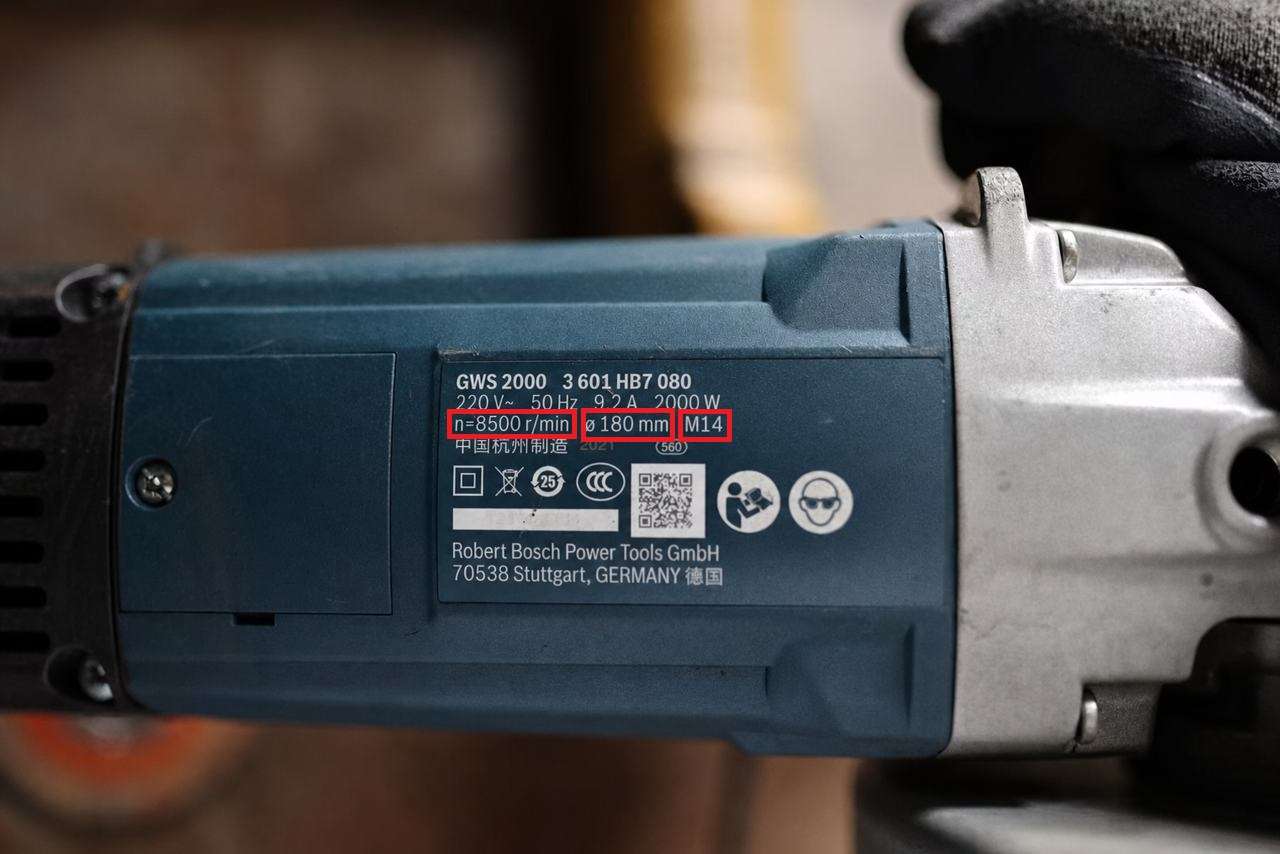
Take this angle grinder as an example. It is designed for 180 mm (7 inch) discs. It has an M14 spindle thread and a no-load speed of 8,500 RPM; therefore, the maximum speed of the selected disc must be equal to or greater than 8,500 RPM.
How to Cut Metal With an Angle Grinder?
Step1 : Preparation
First, you should wear safety goggles, gloves, and earplugs. The protective shield should be positioned between you and the cutting wheel so that it blocks sparks and debris.
Second, check every metal cutting disc for quality defects, expiration, or unclear labeling. Do not use damaged or unidentified cutting wheels.
Then, you need to clear the work area. Remove combustible materials such as wood shavings, paper, solvents, flammable gases, and dust. Before cutting coated metals, verify the coating composition and ventilation plan.
Step2 : Install and Inspect the Angle Grinder
- Inspect the angle grinder: Check that the switch, power cord, flange, and spindle are not damaged.
- Unplug the power cord before installation.
- Tighten the wheel clamp securely, but do not overtighten it or forcefully alter the hole diameter.
Points to Note for Cutting Wheels of Different Thicknesses:
| Disc Type | Common Thickness | Lock Nut Direction | Reason |
| Thin cutting discs | 0.8–1.6 mm 1/32″–1/16″ | Use the flat side of the lock nut against the disc | The raised boss may touch the center hole and fail to clamp the thin disc properly |
| Thick cutting discs | 2.5–3.2 mm 3/32″–1/8″ | Use the raised boss side of the lock nut toward the wheel | The raised boss helps center and secure the thicker wheel |
Step3 : Secure Your Metal
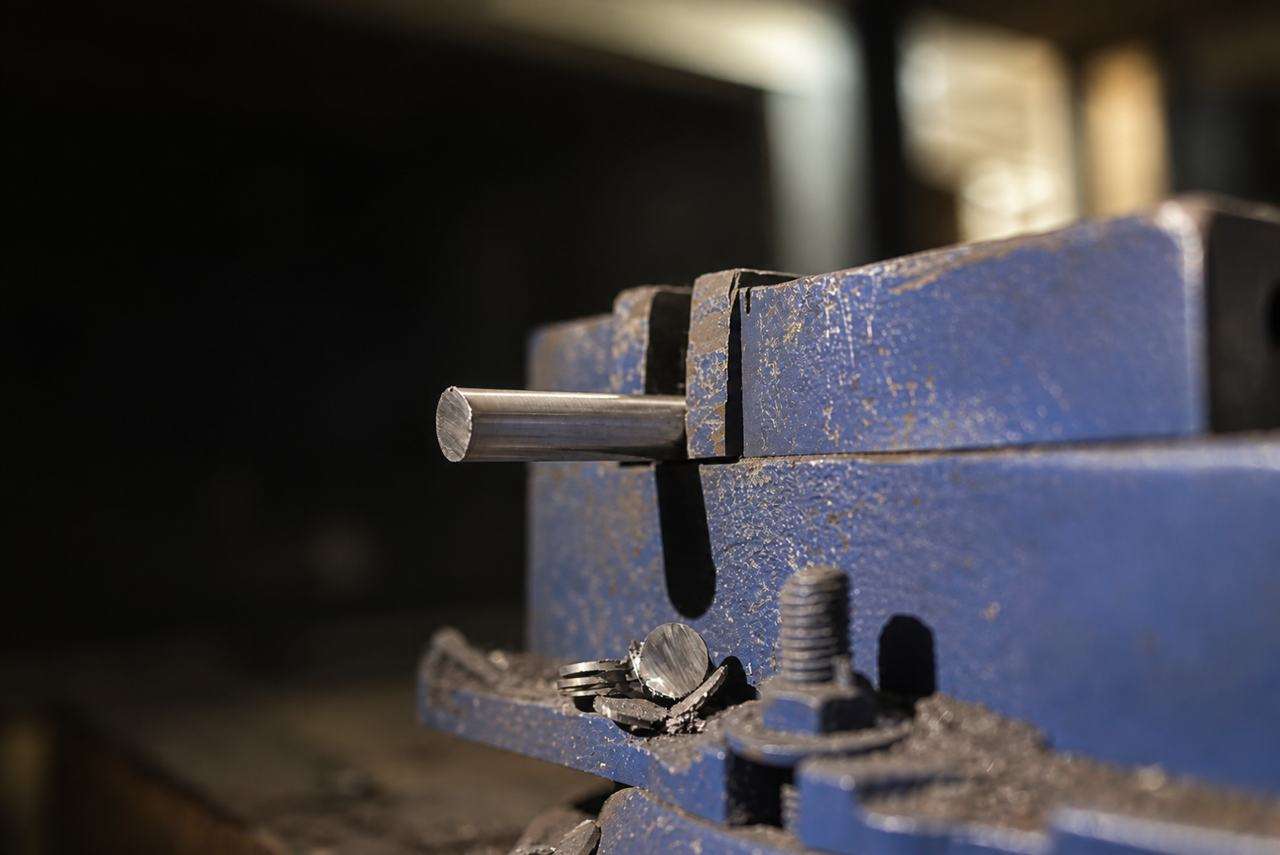
Cutting things while holding the workpiece will increase the risk of it flying off. You must secure the workpiece with a fixture or vise, ensuring it is supported on both sides of the cut to prevent the disc from getting caught as you finish the cut.
Step4 : Start Cutting
- After starting the angle grinder, allow the grinding wheel to reach full speed, check for any abnormal vibration or noise, and only begin cutting metal once you have confirmed everything is normal.
- Cut the metal at a 90-degree angle.
- Apply moderate pressure and do not apply excessive force.
- If the grinding wheel becomes stuck, the angle grinder slows down, or you hear any unusual noises, stop immediately.
- Turn off the tool and wait for the disc to come to a complete stop before setting it down.
Common Mistakes When Cutting Metal With an Angle Grinder
Using a cutting wheel for side grinding
Cutting discs are typically thin, and lateral forces can cause them to bend and break. When grinding is required, you should use metal grinding discs or another product designed for grinding and finishing.
Starting with the disc in the cut
Starting the angle grinder inside the cut can cause the cutting disc to become jammed, resulting in an extremely dangerous kickback accident.
At the same time, the severe torsional stress on the cutting disc caused by the narrow cut can lead to the disc breaking and flying apart instantly, causing serious personal injury.
Cutting without marking the line
If you cut without marking the workpiece, it’s easy to make a human error and cut the workpiece crookedly.
FAQ
What are Angle Grinders Used for?
In addition to cutting, angle grinders are used for grinding and polishing. When equipped with specialized grinding discs or wire brushes, they can easily smooth rough welds, remove rust or paint, and bevel edges for demanding metal and masonry tasks.
What is Top Safety Gear for Cutting Metal with an Angle Grinder?
- An angle grinder mask , goggles, and gloves are essential.
- Wear a long sleeved, 100% heavyweight cotton shirt, specialized welding clothing, or flame resistant clothing; do not wear clothing made of flammable materials.
- Metal cutting releases harmful dust. It is recommended to wear an N95 or P100 respirator according to the work environment.
How to Hold an Angle Grinder?
- Hold the tool steady with both hands.
- Rely on the angle grinder’s own weight and rotational speed to cut naturally.
- Do not push forcefully with your hands.
Corded vs. Cordless Angle Grinder: Which Is Better for Heavy Use?
Corded tools are suitable for long time continuous cutting and at fixed workstations. They do not require stopping to replace or recharge batteries, but the power cord limits mobility.
Cordless tools are suitable for use on boats, outdoors, in tight spaces, or places without power supply. They offer greater mobility. However, you need to ensure you have batteries with sufficient capacity.
Final Thoughts
Have you understanded how to cut metal with an angle grinder? Dome carries grinding wheels compatible with various types of angle grinders. Contact our team for sample availability, formal quotation or professional technical consultation on abrasive selection.