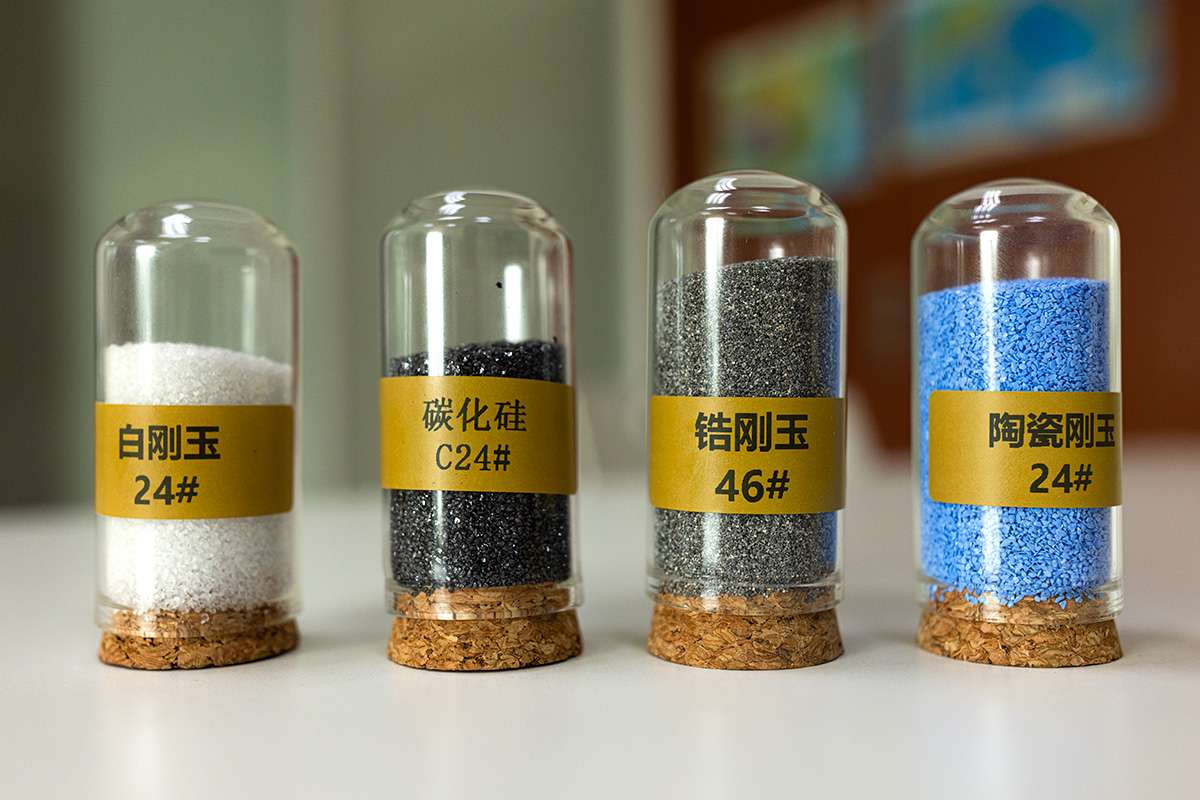
A flap disc and a grinding wheel can overlap in metalworking, but they do not deliver the same results of use. You can’t confuse the two types of tools, as this could prevent you from achieving your desired machining results, reduce work efficiency, and cause the wheels to wear out more quickly.
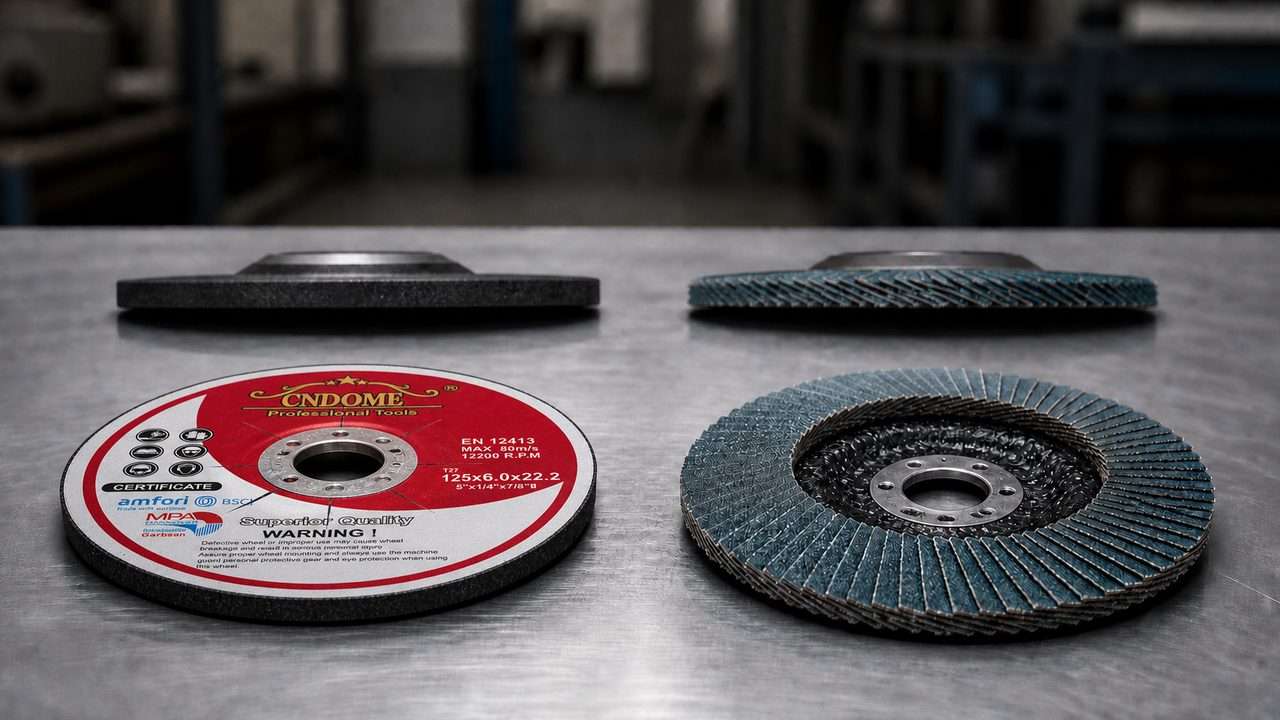
Quick Comparison
The table below summarises the typical selection differences. This gives you a quick overview of the differences between grinding wheels and flap discs, followed by a detailed explanation.
| Comparison Point | Grinding Disc | Flap Disc |
| Main Use | Heavy grinding and fast material removal | Blending, finishing, and light grinding |
| Material Removal Rate | Very high | Medium |
| Surface Finish | Rough finish | Smoother and more uniform finish |
| Surface Roughness | High | Medium to low |
| Vibration | Higher vibration | Less vibration |
| Durability | Wears down faster | Longer service life |
| Heat Generation | Higher heat | Lower heat |
What is a grinding Disc/Wheel?
The grinding disc is a bonded abrasive with a thick body. It is designed for grinding and material removal. It can offer strong grinding ability and can withstand long-term grinding.
What is a Flap Disc?
The flap disc wheel is a collection of abrasive cloth strips that are spread and attached to a plate, either made of plastic or metal. It combines the powerful impact of a grinding wheel with the flexibility and malleability of sandpaper. What’s more, flap discs belong to coated abrasives.
Main Differences Between Grinding Disc and Flap Disc
Common Applications
The application name alone cannot fully determine the tool selection. For example, a weld finishing task involves three stages. Different tools should be selected for each stage.
First, you may use an aluminum-oxide grinding wheel for metal (24 or 36 grit, 6mm thick) to conduct rapid removal of the raised surface. Second, use a T29 zirconia flap disc (40 or 60 grit) with a flap disc grinder to blend with the base material. Third, you can use the flap disc in 80 or 120 grit for final texturing.

The following are general applications for both.
- Grinding Disc
Heavy-Duty Surface Preparation: Rapid removal of thick weld beads and thick scale.
Heavy-Duty Edge Preparation: Removal of hardened layers and heavy slag from the edges of cut seams on thick plates.
Burr and Flash Grinding: Rough grinding of sprues and flash on cast iron parts.
Grooving: Rough machining of V-grooves on thick steel plates or pipes prior to welding.
- Flap Disc
Surface Finishing: Smoothing and finishing butt welds; evening out surface scratches.
Edge Trimming: Chamfering and deburring the edges of laser-cut and stamped parts.
Rust and Paint Removal: Removing scale, surface rust, or old paint layers from metal surfaces without damaging the base material.
Stainless Steel and Aluminum Surface Finishing: Brushing transitions and surface pretreatment before polishing.
The query ”what is a flap disc used for?” usually refers to these blending, deburring, and finishing tasks.
Material Removal Rate
- Grinding Disc
The grinding wheel has a very high material removal rate, far exceeding that of flap wheels and other wheels. It bears the pressure across its entire surface with a relatively concentrated contact area, making it highly effective for rapidly grinding down and removing protrusions. If you need to remove a large amount of material quickly, this is the best choice.
- Flap Disc
The material removal rate of the flap disc is slightly lower, and its gentle contact allows it to conform better to the workpiece surface, ensuring uniform processing.
Surface Finish
- Grinding Disc
Grinding discs are classified as heavy-duty grinding tools and leave behind deeper, more obvious grinding marks. For instance, if the tool is tilted or unstable during your operation, it often creates gouges, potentially needing a subsequent fine grinding step. Its surface roughness is high (Ra > 6.3 μm / 250+ μin).
- Flap Disc
The flap disc uses the edge to contact with the workpiece, causing the abrasive cloth to bend slightly, so the contact is not as firm as that of a grinding wheel. Surface roughness is medium to low (Ra 0.8–3.2 μm / 32–125 μin). The grinding marks it leaves are typically more uniform. It is easier to achieve a smooth finish when you grind the weld area and the surrounding surface.
Vibration
- Grinding Disc
The rigid structure transmits force directly to the operator. When working with a grinding wheel, the impact and vibration felt in your hands are usually more pronounced, and the grinding noise generated by vibration is almost 95–102 dBA.
- Flap Disc
A flap disc grinder use case can feel smoother. The layered sandpaper sheets are elastic, which helps cushion the impact and absorb shock.
| Metric | Grinding Disc | Flap Disc |
| Vibration Level | High | Low to Moderate |
| Operational Impact | Severe high-frequency chatter; faster operator fatigue | Smooth gliding action; reduced strain and arm vibration |
| Causes of Vibration | Disc imbalance, surface bouncing, uneven wheel wear | Worn flaps adapt, minimizing bouncing and uneven hit |
Durability
- Grinding Disc
It continuously shrinks during use, and the shape of the wheel also changes. It is typically used for heavy-duty grinding, so that causes the wheel to wear down more rapidly.
- Flap Disc
During use, a flap disc continuously exposes new abrasive grains. This characteristic effectively extends its service life and makes it more durable than a grinding wheel.
Heat

- Grinding Disc
The body of a grinding wheel is relatively rigid, concentrating grinding pressure on a small contact area. As a result, local temperatures tend to rise more rapidly. The heat can reach approximately 700–1200°C. When the grinding wheel becomes dull, excessive pressure is applied, or the wheel remains in one spot for too long, it causes discoloration, deformation, or surface burn marks.
- Flap Disc
Flap discs distribute contact pressure more evenly and have some gaps between the abrasive pads, which promote airflow. They generally generate heat below 200 degrees Celsius and typically do not cause discoloration. You can use them to process stainless steel, thin sheets, and workpieces that are prone to deformation or discoloration.
How to Choose the Right Disc Between Grinding Disc and Flap Disc?
Choosing the best grinding wheel or the best flap disc depends on the workpiece material, workpiece shape, disc shape, safety risk, productivity and total cost.
Workpiece Material
When you search for the best grinding disc for metal, you should match the wheel specification to the workpiece.
- Grinding wheel
Metal grinding discs are best suited for carbon steel, cast steel, and other workpieces that require rough grinding with a large stock removal rate. A heavy-duty grinding wheel can concentrate pressure on the target area and remove material quickly to remove welds, burrs, or thick scales. However, when used on stainless steel, aluminum, or non-ferrous metals, you must select a product that is clearly marked on the wheel cover as suitable for that material.
- Flap disc
Flap discs can be used on carbon steel, stainless steel, aluminum, and various alloys, but the abrasive and formulation must be selected based on the material. An aluminum oxide flap disc is commonly used for general-purpose steel. The zirconia alumina flap disc for heavy-duty steel, and the ceramic alumina flap disc for stainless steel or high-strength alloys are recommended for your work.
The CCOHS notes that soft materials such as aluminum and brass can clog standard grinding wheels. OSHA also warns that mixing steel and aluminum dust can trigger a violent reaction. Therefore, one disc should not be used for different materials.
Workpiece Shape
The grinding wheel is better suited for linear grinding on flat workpieces.
The flap disc is better suited for curved surfaces and uneven surfaces.
Disc Shape
Discs of different shapes have different operating angles when using an angle grinder.

- T27 grinding wheel
Type 27 grinding wheel has a depressed-center shape. The thickness is usually 6mm(1/4 in), which is thicker than other discs. They are commonly used at a working angle of about 15° to 30°.
- T27 flap disc
The T27 angle grinder flap disc has a relatively flat surface, making it suitable for use at smaller angles, typically 0°–15°. Because it has a larger contact area, it is better suited for surface blending, light-to-moderate removal, and final texturing.
- T29 flap disc
The T29 flap disc is a conical flap grinding wheel with an upward-curving bevel on its outer edge. The abrasive grains are concentrated at the contact points, giving it greater grinding capacity than the T27. The typical operating angle is 15°–25°.
The comparison between type 27 vs 29 flap disc is a choice between a flatter face and a conical face, not a change in abrasive material.
Safety Risk
Improper operation of grinding wheels can easily lead to sudden, catastrophic disintegration and the generation of high-temperature sparks. Flap discs typically produce less vibration and reaction force, carry a relatively low risk of bursting, and are easier to handle.
When making a choice, you cannot say that a flap disc is safer than a grinding wheel. Both can only be guaranteed to be safe when the operating instructions are strictly followed.
Productivity and Total Cost
For industrial sourcing, compare cost per accepted part rather than unit price alone. Include abrasive consumption, cycle time, rework, rejected parts, labour and the required finish.
Grinding wheels are generally inexpensive and offer good value for money. Their high material removal rate improves production efficiency. If you use them for rough grinding in the initial stage of the process and then switch to another wheel for fine grinding, the actual cost also includes the cost of the second consumable.
When a large amount of material needs to be removed and subsequent finishing is required, grinding discs are generally more suitable for you.
Flap discs are generally more expensive, but the grinding speed is more stable. Operators are less prone to fatigue, and secondary processing time is reduced.
When a moderate amount of material needs to be removed, and a high-quality surface finish is desired, you can choose the flap disc. It can reduce overall processing costs by minimizing the need for subsequent finishing steps.
FAQ
Do Grinding Discs and Flap Discs Have an Expiration Date?
The shelf life for grinding wheels is strictly 3 years according to EN 12413/ANSI standards, while flap discs typically have a shelf life of 3 to 5 years. However, the specific expiration date marked on the product itself should always be followed.
What Grit Flap Disc for Rust Removal?
60-grit flap disc: Suitable for general rust layers, balancing rust removal efficiency with surface finish.
80-grit flap disc: Suitable for light surface rust and pre-painting preparation; leaves shallower scratches.
How to Clean a Flap Disc?
Cleaning the flap disc can extend their service life, but you should never wash it with water or chemical solvents. You should use an angle grinder with a rubber scraper to remove dirt, manually remove it with a wire brush, or blow it clean with a high-pressure air gun.
Can I use a flap disc until all the abrasive flaps are gone?
When a flap disc worn out is answered by the backing plate and flap condition. Stop using the flap disc when the backing plate becomes exposed. The flaps begin to tear or separate, then the disc no longer cuts effectively. Continuing to grind may damage the backing plate and increase the risk.
Final Thoughts
The previous section provided a detailed comparison, so you can choose the disc by material, required finish, and total process cost. As an industry-leading manufacturer with an automated workshop, Dome is a company you can trust. Build win-win cooperation with us!