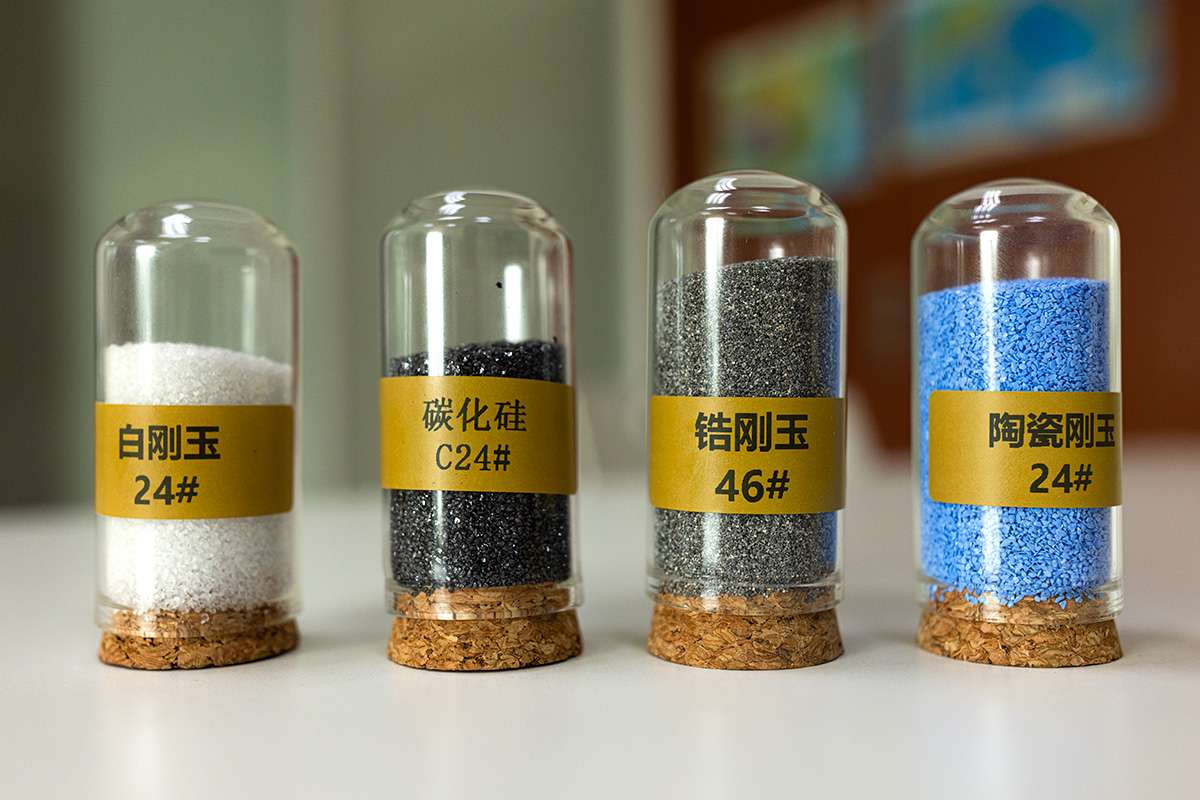
Faced with complex materials, are you sure which type of grinding wheel suit for your application? Incorrect combinations can lead to slow grinding speed and fast grinding wheel consumption, even safety problems. It’s tough work to choose the right one. Here is a grinding wheel buying guide for your selection.
Types of Grinding Wheels
Aluminum Oxide Grinding Wheels
Aluminum oxide grinding wheel is a common abrasive type in traditional metal grinding. You can buy it for its good toughness, strong impact resistance, stable grinding performance, and high cost-effectiveness.
Through different materials such as brown fused alumina , white fused alumina , chromium fused alumina, and ceramic fused alumina, it can perfectly cover your various needs from heavy-duty industrial rough grinding to high-precision tool sharpening.
Zirconia Alumina Grinding Wheels
Zirconia alumina abrasive grains have high toughness and high self-sharpening ability ,thus they can withstand high grinding loads and work at high speeds. They are mainly employed for grinding welds, beveling operations, and large amounts of materials removed. As compared with conventional aluminum oxides, zirconia abrasives are more suitable for your high rates of material removal and coarse grinding needs.
Ceramic Alumina Grinding Wheels
Corundum ceramic grinding wheels specially developed for materials hard to process and very high hardness materials. Their most revolutionary technology is that of their microscopic self sharpening ability, which means that while regular corundum wears out in one piece, the grains of the abrasive break up layer by layer.
You can use it for high-performance T27 grinding discs and special machine tool grinding wheels.
Silicon Carbide Grinding Wheels
Silicon Carbide has properties such as hardness, brittleness and sharpness of the cutting edges that provide quick and light cuts. Silicon Carbide Grinding Wheel is useful in machining cast iron, non-ferrous metals, glass, ceramics, stone, brick, and concrete. This is because the abrasive grains tend to fracture easily and provide sharp cutting edges.
Steps to Choose A Grinding Wheel
There are steps to follow before you make a final choice. First, you should know what type of grinding wheel is compatible with your machine. Second, you should be clear what workpiece material you want to deal with. Third, you need to learn more about specific grinding wheel specifications.
Step 1: Match The Wheel to The Grinder
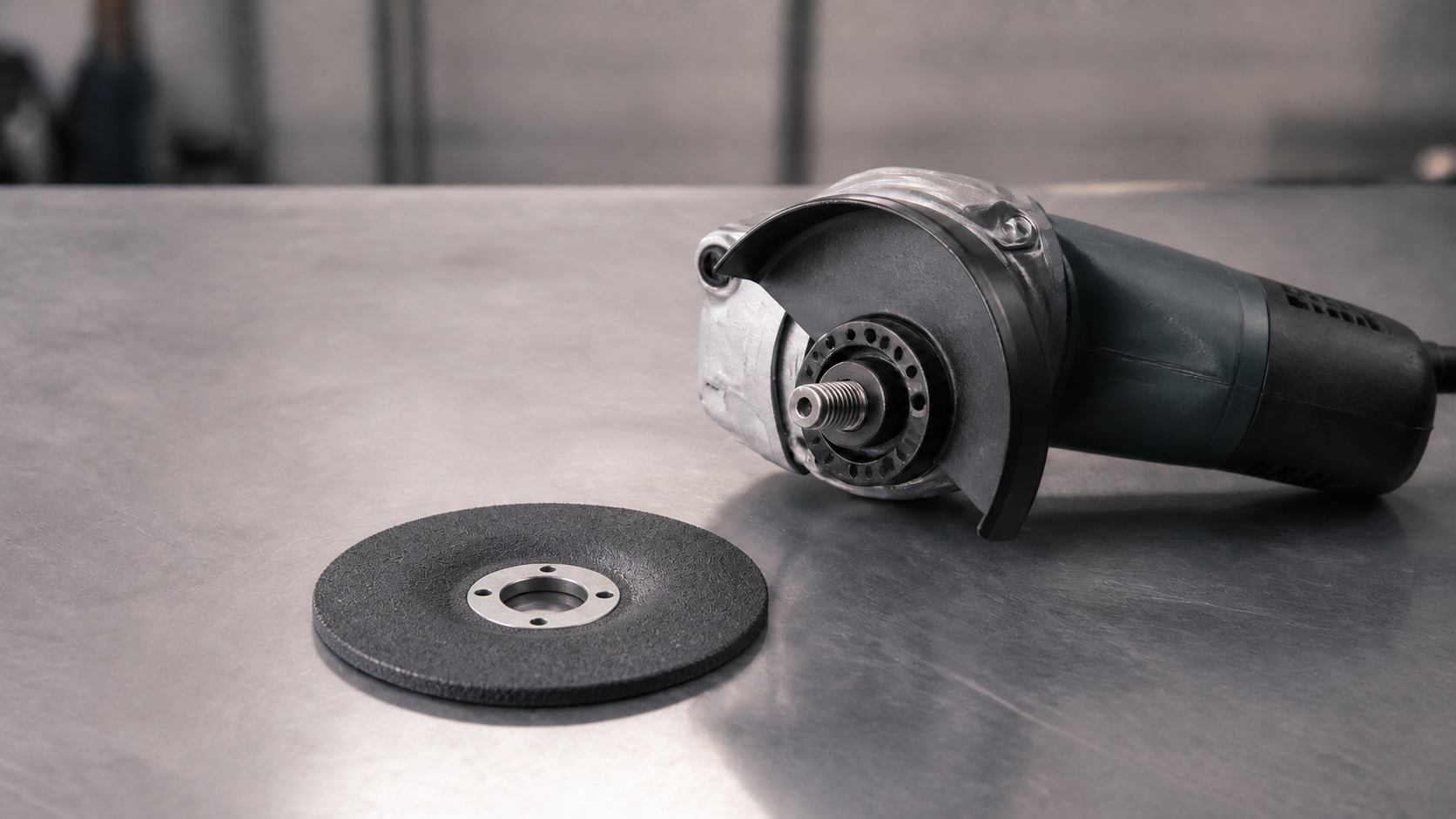
This step is not only the first step but also an important safety step. UHS—he UK’s Health and Safety Executive lists machine speed, machine type, and wheel size and shape as important factors when ordering grinding wheels.
Taking the grinding wheel for angle grinder as an example, you must first check the tool to see if it approves the type of grinding wheel. Regarding size, the outer diameter of the wheel must not exceed the dimensions allowed by the tool and guard. The bore or thread must be perfectly matched to the spindle and mounting system.
You are not allowed to enlarge the hole, force it in, or modify it with temporary shims. You should know your grinding wheel maximum RPM compatibility. The maximum RPM of the wheel must be equal to or higher than the tool’s maximum no-load RPM.
Step 2: Choose Grinding Wheels by Workpiece Material
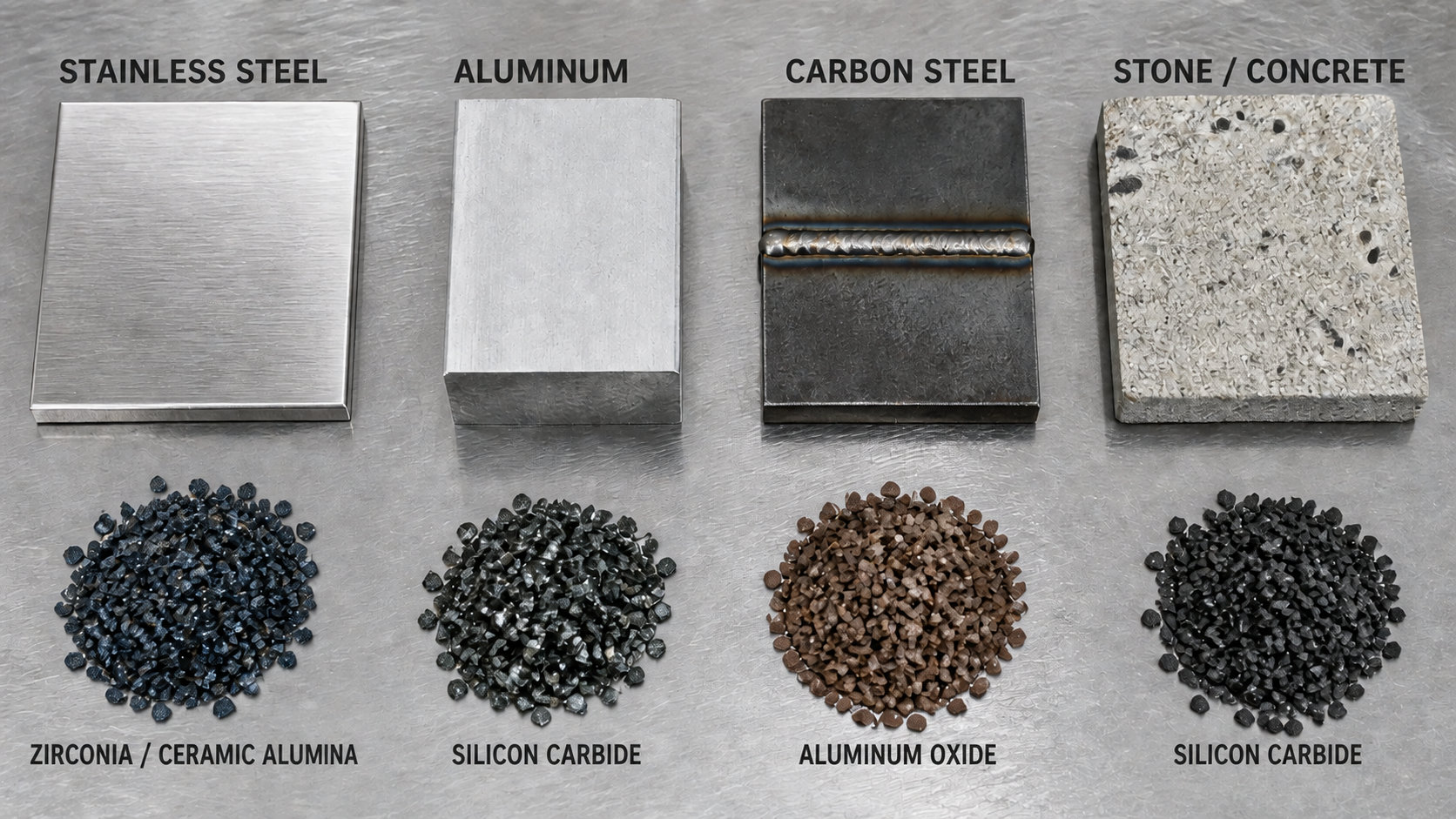
Choose A Grinding Wheel for Stainless Steel
Stainless steel is well-suited for use with zirconia alumina and ceramic alumina grinding wheels. Moreover, T27 grinding discs specifically designated for stainless steel are preferred.
- Zirconia Alumina Grinding Wheels
It is a cost-effective choice. It’s suitable for you to process stainless steel welds and regrinding. The disadvantage is that it requires high pressure to trigger the abrasive grains’ self-sharpening, and its heat generation is higher than ceramic alumina.
- Ceramic Alumina Grinding Wheels
It is the king of performance. With higher cutting efficiency and lower heat generation, it suits automated production lines, large-volume stainless steel weld cleaning and high surface finish requirements. The disadvantage is that your purchase cost is relatively high.
Choose A Grinding Wheel for Aluminum
The core challenge in grinding aluminum is its soft, sticky, and low-melting-point properties, which easily cause ordinary grinding wheels to block. Therefore, it is essential to use silicon carbide grinding wheels with sharp cutting edges or special anti-block alumina grinding wheels. In case of the workpiece which is liable to heat distortion, it is advisable for you to use the fine mesh, soft bonding, and light grinding specification.
Choose A Grinding Wheel for Carbon Steel And Alloy Steel
- Aluminum Oxide Grinding Wheels
For deburring and smoothing welds on ordinary carbon steel, the economical and stable T27 alumina grinding discs are the first choice.
- Zirconia Alumina Grinding Wheels
In coarse grinding of heavy welds or heavy allowances in cast steel components, it becomes essential to use tough, strong, and highly impact-resistant abrasives made up of zirconia.
- Ceramic Alumina Grinding Wheels
For efficient and high-efficiency processes in tough alloy steel, your best choice in the ceramic abrasives category can only be ceramic alumina abrasives because of their fine self-sharpening capability and very low heat generation.
Choose A Grinding Wheel for Stone
- Silicon Carbide Grinding Wheels
For stone grinding wheels , the best choice is silicon carbide grinding wheel. It is due to its sharper edge that makes it appropriate for the grinding of brittle mineral materials.
- Diamond Grinding Cup Wheels
Diamond materials are selected where longer cutting life or better dimensional stability is needed. Applicable scenarios: heavy-duty rough grinding, cutting, and chamfering of granite, quartz stone, concrete, and marble.
Step3: Choose Grinding Wheel by Size
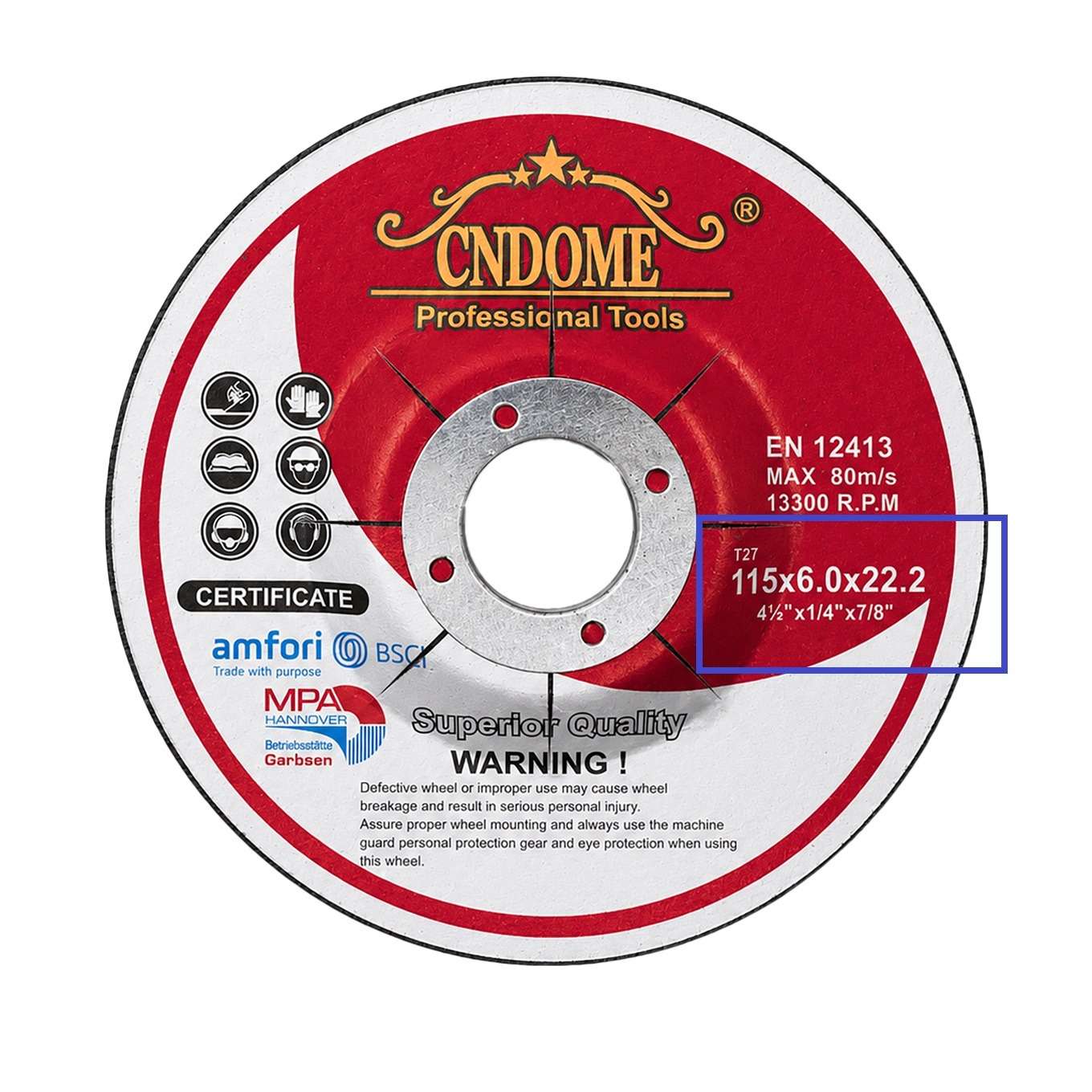
Take this grinding wheel as an example. You can see 115× 6.0× 22.2 in its cover. That means the grinding wheel has 115mm outer diameter, 6mm thickness and 22.2 hole diameter. For a fractional inch, it is about 4 1/2 × 1/4 × 7/8 inches.
The outer diameter decides the grinding wheel’s peripheral speed.The larger the outer diameter of the grinding wheel, the higher the linear velocity (m/s) of the outer edge at the same rotational speed.
The grinding wheel thickness plays an important role in determining the amount of surface that is covered in one pass. The larger the wheel thickness is, the greater the surface coverage for each pass.
The wheel bore must be able to fit with the grinding machine holder.
Grinding Wheel Size Chart Explained
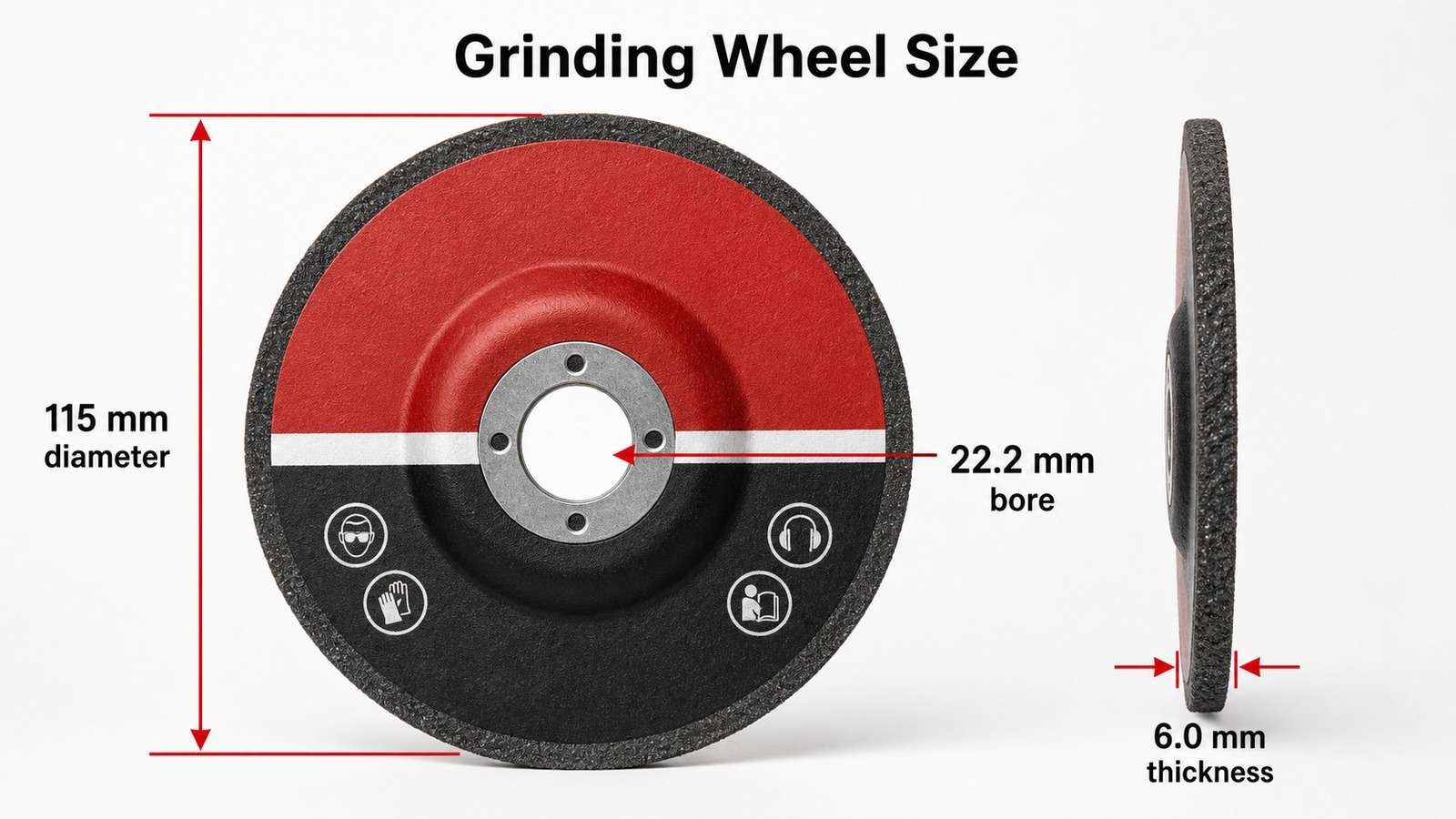
The chart includes 4 inch grinding wheel, size4.5 inch grinding wheel, 5 inch grinding wheel and so on.
| Diameter | Thickness | Bore Size | Common Application |
| 4″ (100 mm) | 1/4″ (6 mm) | 5/8″ (16 mm) | Small angle grinder, light grinding |
| 4-1/2″ (115 mm) | 1/4″ (6 mm) | 7/8″ (22.22mm) | Most common handheld grinding applications |
| 5″ (125 mm) | 1/4″ (6 mm) | 7/8″ (22.22 mm) | General fabrication work |
| 6″ (150 mm) | 1/4″ (6mm) | 7/8″ (22.22 mm) | Heavy-duty grinding |
| 7″ (180 mm) | 1/4″ (6mm) | 7/8″ (22.22 mm) | Structural steel, heavy grinding |
| 9″ (230 mm) | 1/4″ (6mm) | 7/8″ (22.22 mm) | Heavy material removal |
Step4: Choose Grinding Wheel by Grit
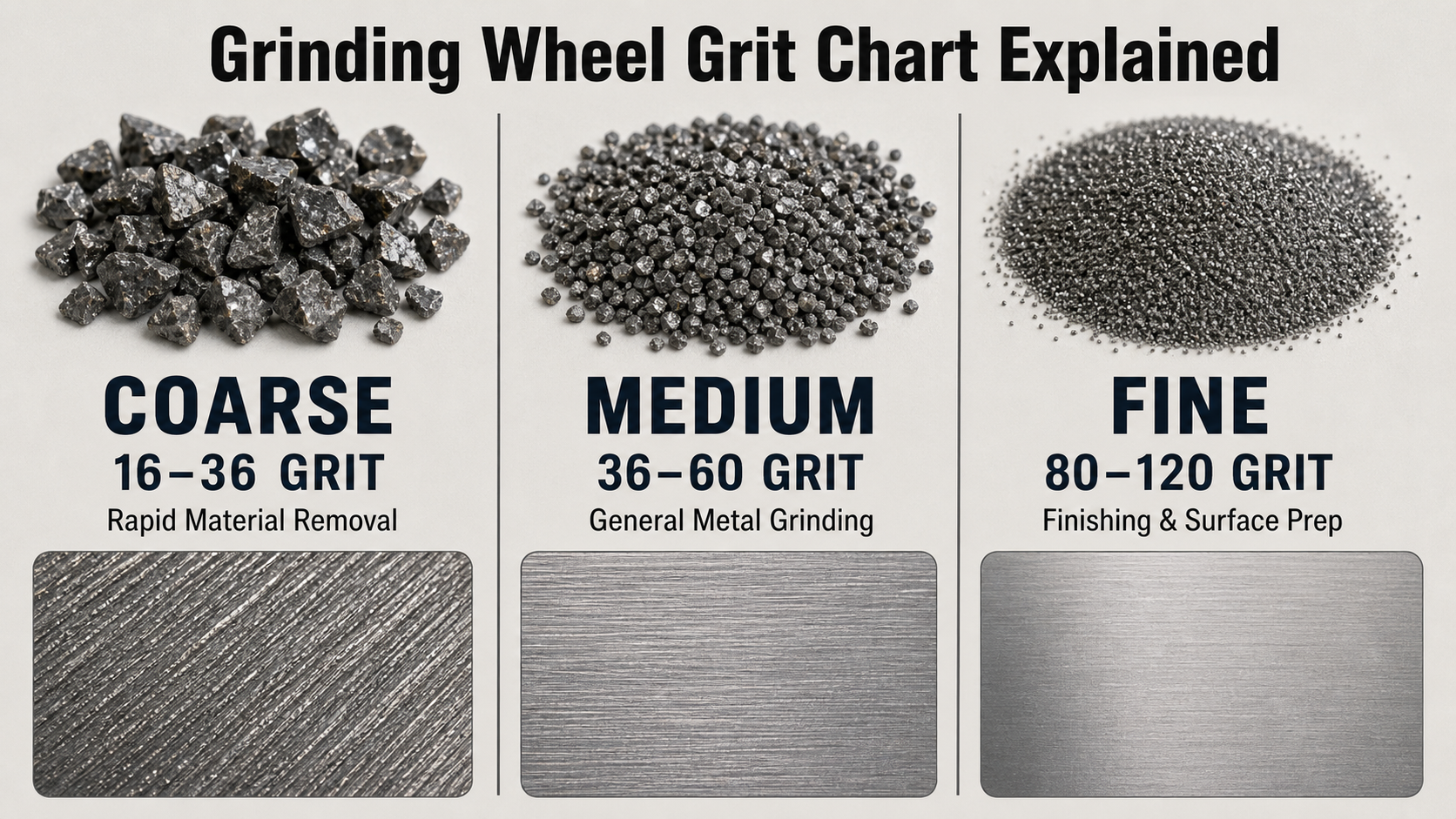
Grinding wheel grit sizes are classified into 37 particle size grades according to the abrasive grain size.
Generally speaking, 16-36 grit grinding wheels are suitable for rapid material removal. 30-60 grit wheels are suitable for most metal processing scenarios. 80-120 grit wheels are mainly used for surface treatment, finishing, and applications with high surface quality requirements.
Grinding Wheel Grit Chart Explained
| Application | Recommended Grit Size | Recommended Abrasive |
| Heavy Weld Removal | 16–36 grit | Zirconia Alumina Ceramic Alumina Aluminum Oxide |
| General Metal Grinding | 36–60 grit | Aluminum Oxide Zirconia Alumina |
| Edge Grinding & Deburring | 24–46 grit | Aluminum Oxide Zirconia Alumina |
| Surface Blending | 60–80 grit | Aluminum Oxide Ceramic Alumina |
| Stainless Steel Finishing | 80–120 grit | Ceramic Alumina Premium Aluminum Oxide |
| Tool Sharpening | 80–120 grit | White Aluminum Oxide Ceramic Alumina |
| Heavy Stock Removal | 16–36 grit | Zirconia Alumina Ceramic Alumina |
| Weld Blending | 60–100 grit | Ceramic Alumina Zirconia Alumina |
| Rust Removal & Surface Preparation | 36–80 grit | Aluminum Oxide Zirconia Alumina |
| Precision Grinding | 80–120 grit | White Aluminum Oxide CBN |
Step5: Choose Grinding Wheel by Other Specifications
Grinding wheel grade and hardness affect how the bond retains abrasive grains, so they should be selected with the full wheel formulation and task in mind.
Grinding wheel bond selection should be evaluated together with the abrasive, grade, workpiece material, contact area, and operating speed.
Common Mistakes When Choosing a Grinding Wheel
- You cannot only check the bore diameter, ignoring the outer diameter, guard, flange, and RPM.
- You absolutely should not use grinding wheels for cutting, or use cutting wheel to grind.
- You assume that harder discs are necessarily more durable and cheaper, ignoring passivation, pressure, heat generation, and processing time.
- You mistick that ceramic abrasives are always superior to zirconium oxide or ordinary alumina, ignoring contact conditions and complete formulation.
- You are forbidden to use general purpose steel discs to grind aluminum, or to use ordinary steel tools to process stainless steel with pollution control requirements.
- You are wrong when only comparing single disc lifespan, without recording removal per unit time, disc replacement time, and rework.
- You can’t treat a single manufacturer’s recommended angle, pressure, or performance percentage as industry standard.
- You should not identify wheel applications based on color. Color is not a universally accepted selection standard across manufacturers.
How to Buy Grinding Wheels
Define Your Grinding Requirements
You are supposed to provide useful messages rather than “I need grinding wheels”. You can tell the supplier your application, workpiece material, wheel size, machine, desired performance and so on.
For example:
125 × 6 × 22.22 mm
Mild steel
Weld grinding
Angle grinder
Heavy stock removal
Evaluate Grinding Performance
To understand how to test grinding wheel performance, compare products under the same machine, material, operating conditions, and task
You can request samples, not just test whether a single piece “works”. You are best to make a comparative grinding test and make comparison with existing supplier products.
Cutting efficiency, grinding wheel life, material removal rate, heat generate and surface finish are all factors you need to test and compare.
Check Safety and Certificates
You need to confirm the applicable standards, product testing requirements, safety markings, maximum speed markings, traceability, and certification requirements based on the market. You had better figure out if the suppliers have the authoritative product certification, such as EN 12413, ISO 9001 and OSA.
Ask OEM Capabilities
When selecting a grinding wheel manufacturer, you should also check whether they can provide customization services, including private labeling, logo printing, custom labels, and customized packaging. In addition, suppliers may offer options such as different colors, sizes, and grit specifications to meet specific market requirements and application needs.
FAQ
How do I select the best grinding wheel for metalworking tasks?
Metalworking tasks are extensive and involve many choose.When selecting your most appropriate grinding wheel, you can follow the three questions: “material – process – model”. Use for which material? Use for what metalworking process? Use for what size model?
What Are Grinding Wheels Made of?
A grinding wheel is essentially a composite bonded tool in which abrasive grains are fixed by a bonding agent. It is mainly composed of three elements: abrasive grains, bonding agent, and pores.
How Does a Grinding Wheel Work?
Micro-cutting: When the grinding wheel is spinning at a high speed and contact with the workpiece, many abrasive grains that are present in the outermost layer of the grinding wheel scrape the metal surface by a very small amount, forming tiny chips of material.
Self-sharpening: In grinding operations, the abrasive grains wear off and are increasingly exposed to friction. When the frictional force exceeds a certain limit, the worn out abrasive grains break up to reveal sharper edges or come out of the bond exposing the sharper grains beneath.
Can a steel grinding wheel be used on aluminum?
Under normal circumstances, it is not possible. Only if the label explicitly approves aluminum or the target non-ferrous material. Soft metals can load an unsuitable wheel.
Final Thoughts
Our Dome is a professional abrasive wheel manufacturer ,which provides high quality grinding wheels, customized solutions, and OEM services. With expertise in abrasive selection, grit options, and application requirements, we help you choose the right wheel for better efficiency, durability, and safety. Contact us today for your grinding solution.